A Cube of Linear Elastic Material Is Again Subjected
8. Mechanics of Elastic Solids
In this affiliate, nosotros apply the general equations of continuum mechanics to elastic solids.
As a philosophical preamble, information technology is interesting to contrast the challenges associated with modeling solids to the fluid mechanics issues discussed in the preceding chapter. In fluid mechanics, at that place tends to be little debate about the selection of a model to draw the behavior of the fluid itself oft, relatively simple idealizations, such as the Eulerian fluid, or Newtonian Viscid behavior, are sufficient. This is because a lot of fluid mechanics is concerned with loftier Reynolds number flows, in which example inertia forces are much more important than the forces generated by the deformation.
Inertia nearly always plays a secondary function in solid mechanics issues (once more, there are exceptions, such as in modeling a car crash or explosion, but the majority of solid mechanics is concerned with quasi-static equilibrium). The internal forces generated by the deformation itself boss the response. Characterizing the stress-strain relation of the material thus becomes a paramount concern. As a consequence, there are huge numbers of dissimilar material models for solids. These models must be chosen and calibrated carefully in whatsoever awarding.
There are three general classes of textile model for solids
1. Elasticity (with or without heating furnishings). Fabric behavior in these models is perfectly reversible whatsoever irreversibility comes from rut flow effects, which are oft neglected.
ii. Viscoelasticity these materials display irreversible and possibly time-dependent behavior, merely the irreversible response is modeled using fairly uncomplicated linear relations betwixt stress and charge per unit of deformation
3. Plasticity plasticity models business relationship for irreversible behavior using sophisticated nonlinear relations.
Nosotros volition not be able to talk over all these material models in item in this form there are entire courses devoted to the theory of elasticity, viscoelasticity and plasticity, which yous are no dubiousness looking forwards to taking. Instead, we will focus on the 2 simplest ones: elastic, and viscoelastic cloth behavior. The discussion serves two purposes. Firstly, to illustrate how constitutive relations for solids are constructed; and secondly, to provide a brusk introduction to some of the methods that are used to solve solid mechanics problems.
8.1 Overview of rubberband material models
There are two general types of elastic fabric.
Linear rubberband constitutive relations model reversible behavior of a material that is subjected to pocket-size strains. Almost all solid materials tin be represented by linear rubberband constitutive equations if they are subjected to sufficiently small-scale stresses. Since the strains are minor, all the governing equations for linear elastic materials can be linearized, and are therefore relatively like shooting fish in a barrel to solve. Linear elasticity theory is thus the best known and most widely used co-operative of solid mechanics.
 Hyperelastic constitutive laws are used to model materials that respond elastically when subjected to very large strains. They account both for nonlinear material beliefs and big shape changes. The master applications of the theory are (i) to model the rubbery behavior of a polymeric textile, and (ii) to model polymeric foams that can be subjected to large reversible shape changes (e.g. a sponge).
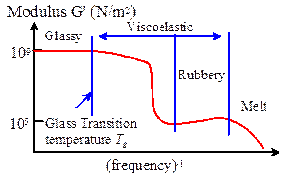
In general, the response of a typical polymer is strongly dependent on temperature, strain history and loading rate. The behavior will be described in more than detail in the next section, where we nowadays the theory of viscoelasticity. For now, we annotation that polymers take various regimes of mechanical behavior, referred to as `glassy,' `viscoelastic' and `rubbery.' The diverse regimes can be identified for a item polymer by applying a sinusoidal variation of shear stress to the solid and measuring the resulting shear strain amplitude. A typical result is illustrated in the figure, which shows the apparent shear modulus (ratio of stress amplitude to strain amplitude) equally a function of temperature.
At a critical temperature known as the drinking glass transition temperature, a polymeric textile undergoes a dramatic modify in mechanical response. Below this temperature, it behaves similar a glass, with a stiff response. Virtually the glass transition temperature, the stress depends strongly on the strain charge per unit. At the glass transition temperature, there is a dramatic drib in modulus. Above this temperature, there is a government where the polymer shows `rubbery' behavior the response is rubberband; the stress does non depend strongly on strain rate or strain history, and the modulus increases with temperature. All polymers evidence these full general trends, but the extent of each regime, and the detailed beliefs within each government, depend on the solid'southward molecular structure. Heavily cross-linked polymers (elastomers) are the most likely to show ideal rubbery behavior. Hyperelastic constitutive laws are intended to approximate this `rubbery' behavior.
Features of the behavior of a solid rubber:
ane. The material is shut to ideally elastic. i.east. (i) when deformed at constant temperature or adiabatically, stress is a function just of current strain and independent of history or rate of loading, (ii) the beliefs is reversible: no net work is washed on the solid when subjected to a closed bicycle of strain nether adiabatic or isothermal conditions.
2. The material strongly resists book changes. The bulk modulus (the ratio of volume alter to hydrostatic component of stress) is comparable to that of metals or covalently bonded solids;
3. The material is very compliant in shear shear modulus is of the order of
times that of most metals;
4. The material is isotropic its stress-strain response is independent of material orientation.
five. 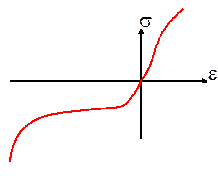 The shear modulus is temperature dependent: the fabric becomes stiffer as it is heated, in sharp contrast to metals;
six. When stretched, the material gives off heat.
Polymeric foams (e.g. a sponge) share some of these properties:
1. They are close to reversible, and show piddling rate or history dependence.
2. In contrast to rubbers, most foams are highly compressible majority and shear moduli are comparable.
three. Foams have a complicated true stress-true strain response, by and large resembling the figure to the right. The finite strain response of the foam in pinch is quite unlike to that in tension, because of buckling in the cell walls.
iv. Foams can be anisotropic, depending on their jail cell structure. Foams with a random prison cell structure are isotropic.
In the following, we will talk over both types of constitutive relation. Maybe perversely, nosotros kickoff with the more than circuitous, hyperelastic model first. The governing equations for the nonlinear example can then be linearized to obtain the simpler theory of linear elasticity.
eight.2 Summary of governing equations for rubberband solids
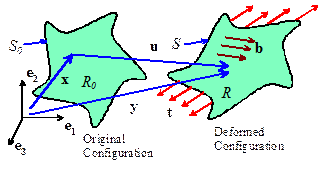
Different fluids, solids near always have a well- divers reference configuration (there are a few exceptions for example a solid could alter its shape by diffusion, or a biological material could grow). When solving a solid mechanics problem, we therefore have the choice to write the governing equations in terms of deformation and forcefulness measures associated with the reference configuration, if this is convenient.
The central trouble in a solid mechanics problem is by and large to determine the displacement field
, Cauchy stress distribution
(or some other stress measure) and (sometimes) temperature
, as functions of position (usually as function of position in the reference configuration) and time. The solid is characterized by the following physical quantities:
 The mass density
per unit reference volume
The specific internal energy
The specific entropy
The specific Helmholtz gratis free energy
A stress response function, e.1000.
. Here,
is the fabric stress
i can use response functions for other stress measures as well.
A oestrus flux response office
. In bodily calculations for solids information technology is frequently preferable to ascertain a oestrus fluxe response function that characterizes heat flow through the reference configuration
an appropriate measure is defined beneath.
Torso forces: The solid is subjected to an external body strength
per unit of measurement mass.
Its move is characterized by the usual deformation measures
Deformation Gradient
The polar decomposition
The Right and Left Cauchy-Green Tensors
Lagrange Strain Tensor
Invariants of the diverse strain tensors. For example, invariants of B are oftentimes used in constitutive models for isotropic hyperelastic materials
An alternative set of invariants of B (more convenient for models of nearly incompressible materials note that
remain abiding under a pure volume change)
Principal stretches and primary stretch directions
1. Let
denote the three eigenvalues of B. The principal stretches are
2. Let
denote three, mutually perpendicular unit eigenvectors of B. These define the principal stretch directions. (Annotation: since B is symmetric its eigenvectors are automatically mutually perpendicular as long every bit no two eigenvalues are the same. If 2, or all three eigenvalues are the same, the eignevectors are not uniquely defined
in this case any convenient mutually perpendicular set of eigenvectors can be used).
iii. Think that B can be expressed in terms of its eigenvectors and eigenvalues every bit
Estrus Period Measures: In fluid mechanics, we always characterize estrus flux by the flow of oestrus through the plain-featured solid. In solid mechanics, it is convenient to introduce another mensurate, divers as
This new rut flux vector tin can be interpreted physically every bit the heat flux crossing an expanse element in the undeformed solid, in the sense that
is the heat flux crossing an area element with expanse
and normal m in the reference configuration.
Stress Measures: Usually stress-strain laws are given as equations relating Cauchy stress (`true' stress)
to left Cauchy-Green deformation tensor. For some computations it may be more convenient to use other stress measures. They are defined below, for convenience.
The Cauchy ("true") stress represents the forcefulness per unit of measurement deformed expanse in the solid and is defined past
Kirchhoff stress
Nominal (Kickoff Piola-Kirchhoff) stress
Textile (2nd Piola-Kirchhoff) stress
Conservation Laws (expressed on the reference configuration)
Mass Conservation
(satisfied trivially)
Linear momentum conservation
Energy conservation
(you should be able to verify for yourself that
and
are work conjugate)
Finally the constitutive law must satisfy the Entropy Inequality:
Transformations nether observer changes:
Deformation Gradient
Left C-G tensor, left stretch
Cauchy Stress
Nominal Stress
Material Stress
8.three Full general course for constitutive equations for elastic solids:
Nosotros now list the about general form of the constitutive equations for elastic solids that are consistent with frame indifference and the entropy inequality. In do, most problems of interest are approximated using ane of several special cases of the general equations. These volition be listed separately.
To be consistent with frame indifference and the laws of thermodynamics, the specific gratuitous energy, internal free energy, Helmholtz costless energy, stress response role and heat transfer office must have the forms
Specific internal energy
Specific entropy
Specific Helmholtz gratis energy
Stress response function
Heat flux response part
It is useful also to introduce the specific heat
So, the stress response role, free free energy, entropy and specific heat capacity are related by
In addition, the oestrus flux function must satisfy
We next summarize the reasoning that leads to these conclusions:
· We assume at the outset that the state of the cloth (and all the constitutive response functions) depend only on the current shape and temperature of the solid, and are contained of load history and the rate of deformation. In addition, we assume that the constitutive behavior is local in other words the constitutive response at a material point depends merely on the shape and temperature of a vanishingly small element of fabric surrounding that point. This ways that the constitutive functions tin can simply depend on the deformation gradient F and temperature
.
· Frame indifference shows that the free free energy office and the stress and heat transfer response functions depend only on C. To see this, notation that frame indifference requires that
for all proper orthogonal tensors
. Recall that
. If we choose
and so
applying frame indifference shows that the stress response functions must accept the course
i.e it must always be possible to express the constitutive functions then that they are functions of C simply (and are thus independent of the rotation in the polar decomposition of F).
· The free energy inequality provides the remaining conclusions. Take the time derivative of the free energy function and substitute into the free energy inequality to run across that
(fourth dimension derivatives are all with fixed x).Collecting coefficients of charge per unit quantities gives
This inequality must concur for all possible
, which tin all be independently prescribed. Information technology follows immediately that
· The first two relations here immediately prove that
The definitions of gratis free energy and heat capacity also show that
Natural Reference Configuration
The preceding equations concord for whatever choice of reference configuration. In many applications information technology is convenient to select the reference configuration and then that it is stress free at some reference temperature. This means that the stress response role and Helmholtz free energy satisfy
eight.iv Restrictions imposed by material symmetry
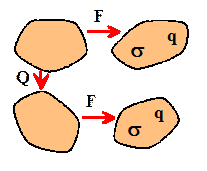
A symmetry transformation is defined as a proper orthogonal transformation of the reference configuration that leaves the material response unchanged. For case, for the complimentary energy
This looks rather similar to the objectivity constraint merely the sequence is important
annotation that F and Q are reversed in this definition.
Yous can visualize this definition as an experiment in which (i) a cloth is subjected to some deformation gradient F and temperature gradient, and the response functions are determined (eg by measuring the stress and heat flux in the deformed solid); and (ii) The specimen is first rotated past a rigid rotation Q and is then subjected to the aforementioned deformation F and temperature gradient, and the stress and heat flux are measured again. If the stress is the aforementioned in both experiments, Q is a symmetry transformation.
Note that nosotros require the complimentary energy, heat flux and Cauchy stress in the deformed solid to be the aforementioned when the cloth is subjected to FQ and F. Since the reference configuration has changed, the material stress and the material heat flux vector are not invariant to a symmetry transformation.
Isotropic solids are of particular interest. These are materials that are unchanged by all proper orthogonal transformations of the reference configuration. For isotropic solids, the constitutive response can exist expressed in terms of the left Cauchy Dark-green tensor. To meet this, note that isotropy requires that
for all proper orthogonal tensors Q. If we let F=VR and cull Q=R, and so
, which implies that
Isotropic materials therefore have a free energy that depends only on B. The nature of the free free energy function is restricted further past objectivity, which requires that
for all proper orthogonal tensors Q. This ways that
can merely be a function of the invariants of B.
The functions themselves must be determined experimentally. Some specific functions that are frequently used are listed in Section seven.5.
8.5 Calculating stress-strain relations from the free free energy
The constitutive police for a hyperelastic material is defined past an equation relating the free energy of the material to the deformation gradient, or, for an isotropic solid, to the iii invariants of the strain tensor. In practice, rather than specifying the specific free free energy, virtually constitutive laws specify the strain energy density (per unit reference volume) rather than the complimentary energy, just to avoid introducing the mass density in the stress-strain relations. The strain energy is related to the Helmholtz gratis energy by
, and tin can be expressed in one of several forms
The stress-strain law must then be deduced past differentiating the complimentary free energy. This can involve some irksome algebra. Formulas are listed below for the stress-strain relations for each choice of strain invariant. The expressions give Cauchy stress which is what we are commonly trying to calculate. The results are derived below
Strain energy density in terms of
Strain energy density in terms of
Strain free energy density in terms of
Strain energy density in terms of
Derivations : We start by deriving the general formula for stress in terms of
:
- The free free energy inequality tin can exist expressed in terms of F and the nominal stress S every bit
two. Therefore,
This must hold for all possible
,and so that
3. Finally, the formula for Cauchy stress follows from the equation relating
to
For an isotropic fabric, it is necessary to notice derivatives of the invariants with respect to the components of F in lodge to compute the stress-strain role for a given strain energy density. It is straightforward, but somewhat tedious to show that:
Then,
and
When using a strain energy density of the form
, we will have to compute the derivatives of the invariants
with respect to the components of F in order to find
We find that
Thus,
Next, nosotros derive the stress-strain relation in terms of a strain energy density
that is expressed as a function of the principal strains. Notation first that
so that the chain rule gives
Using this and the expression that relates the stress components to the derivatives of U,
we find that the principal stresses
are related to the corresponding principal stretches
(square-roots of the eigenvalues of B) through
The spectral decomposition for B in terms of its eigenvalues
and eigenvectors
:
now allows the stress tensor to be written as
8.6 Perfectly incompressible materials
The preceding formulas presume that the material has some (perhaps modest) compressibility that is to say, if you load it with hydrostatic pressure, its volume will modify past a measurable corporeality. Most rubbers strongly resist volume changes, and in hand calculations it is sometimes convenient to approximate them as perfectly incompressible. The material model for incompressible materials is specified equally follows:
The deformation must satisfy J=1 to preserve volume.
The strain energy density is therefore only a function of two invariants; furthermore, both sets of invariants divers in a higher place are identical. We can employ a strain free energy density of the course
.
Because you tin can apply whatever pressure to an incompressible solid without changing its shape, the stress cannot exist uniquely determined from the strains. Consequently, the stress-strain police just specifies the deviatoric stress
. In problems involving quasi-static loading, the hydrostatic stress
tin usually exist calculated, by solving the equilibrium equations (together with appropriate boundary weather). Incompressible materials should non exist used in a dynamic analysis, considering the speed of elastic pressure level waves is infinite.
The formula for stress in terms of
has the form
The hydrostatic stress p is an unknown variable, which must be calculated by solving the boundary value trouble.
8.vii Specific forms of the strain energy density
Generalized Neo-Hookean solid (Adapted from Treloar, Proc Phys Soc sixty 135-44 1948)
where
and
are material properties (for pocket-sized deformations,
and
are the shear modulus and bulk modulus of the solid, respectively). Elementary statistical mechanics treatments predict that
, where N is the number of polymer bondage per unit of measurement volume, grand is the Boltzmann constant, and T is temperature. This is a rubber elasticity model, for rubbers with very limited compressibility, and should be used with
. The stress-strain relation follows as
The fully incompressible limit can be obtained past setting
in the stress-strain law.
Generalized Mooney-Rivlin solid (Adapted from Mooney, J Appl Phys 11 582 1940)
where
and
are material backdrop. For small deformations, the shear modulus and bulk modulus of the solid are
and
. This is a rubber elasticity model, and should be used with
. The stress-strain relation follows as
Generalized polynomial rubber elasticity potential
where
and
are material properties. For small strains the shear modulus and bulk modulus follow as
. This model is implemented in many finite element codes. Both the neo-Hookean solid and the Mooney-Rivlin solid are special cases of the police force (with N=1 and appropriate choices of
). Values of
are rarely used, considering it is difficult to fit such a big number of fabric properties to experimental data.
where
, and
are material properties. For small strains the shear modulus and bulk modulus follow as
. This is a rubber elasticity model, and is intended to be used with
. The stress can exist computed using the formulas in the preceding section, but are too lengthy to write out in full here.
Arruda-Boyce 8 chain model (J. Mech. Phys. Solids, 41, (2) 389-412, 1992)
where
are material properties. For pocket-sized deformations
are the shear and bulk modulus, respectively. This is a rubber elasticity model, so
. The potential was derived by calculating the entropy of a uncomplicated network of long-chain molecules, and the serial is the result of a
Ogden-Storakers hyperelastic cream
where
are cloth properties. For minor strains the shear modulus and bulk modulus follow equally
. This is a foam model, and tin can model highly compressible materials. The shear and pinch responses are coupled.
Blatz-Ko foam rubber
where
is a material parameter corresponding to the shear modulus at infinitesimal strains. Poisson's ratio for such a material is 0.25.
eight.8 Calibrating nonlinear elasticity models
To utilize any of these constitutive relations, you lot will need to determine values for the cloth constants. In some cases this is quite unproblematic (the incompressible neo-Hookean material only has 1 constant!); for models like the generalized polynomial or
Conceptually, however, the procedure is straightforward. Y'all can perform various types of test on a sample of the material, including simple tension, pure shear, equibiaxial tension, or volumetric compression. It is straightforward to calculate the predicted stress-strain beliefs for the specimen for each constitutive law. The parameters can then be chosen to give the best fit to experimental beliefs.
Here are some guidelines on how best to practice this:
ane. When modeling the behavior of safe under ambient pressure, you can usually assume that the material is near incompressible, and don't need to narrate response to volumetric pinch in item. For the rubber elasticity models listed above, yous can have
MPa. To fit the remaining parameters, you can presume the material is perfectly incompressible.
2. If rubber is subjected to large hydrostatic stress (>100 MPa) its volumetric and shear responses are strongly coupled. Pinch increases the shear modulus, and high enough force per unit area can even induce a glass transition (encounter, e.1000. D.L. Quested, K.D. Pae, J.L. Sheinbein and B.A. Newman, J. Appl. Phys, 52, (x) 5977 (1981)). To business relationship for this, you would have to utilise one of the foam models: in the safe models the volumetric and shear responses are decoupled. You would also have to decide the material constants by testing the material nether combined hydrostatic and shear loading.
three. 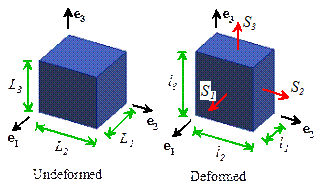 For the simpler textile models, (east.g. the neo-Hookean solid, the Mooney-Rivlin material, or the Arruda-Boyce model, which contain only two material parameters in add-on to the majority modulus) y'all can estimate material parameters by plumbing fixtures to the results of a uniaxial tension test. There are various ways to actually exercise the fit
 y'all could lucifer the pocket-sized-strain shear modulus to experiment, and then select the remaining parameter to fit the stress-strain curve at a larger stretch. Least-squared fits are besides often used. However, models calibrated in this style do not always predict fabric behavior nether multiaxial loading accurately.
iv. A more accurate clarification of material response to multiaxial loading can be obtained by fitting the cloth parameters to multiaxial tests. To assistance in this do, the nominal stress (i.e. force/unit undeformed area) v- extension predicted by several constitutive laws are listed in the table below (assuming perfectly incompressible behavior, as suggested in i.)
| Uniaxial Tension | Biaxial Tension | Pure Shear | |
| Invariants | | | |
| Neo-Hookean | | | |
| Mooney-Rivlin | | | |
| Arruda-Boyce | | | |
| | |||
| | | | |
8.nine Representative values of material properties for rubbers
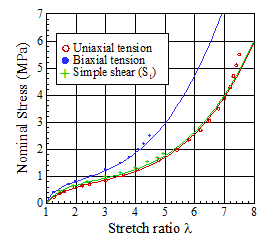
The properties of rubber are strongly sensitive to its molecular construction, and for accurate predictions you will demand to obtain experimental data for the particular textile you programme to employ. As a rough guide, the experimental data of Treloar (Trans. Faraday Soc. 40, 59.1944) for the behavior of vulcanized rubber under uniaxial tension, biaxial tension, and pure shear is shown in the picture. The solid lines in the figure bear witness the predictions of the
Material parameters fit to this information for several constitutive laws are listed below.
viii.10 Instance purlieus value problems with large deformations
The equations governing big deformation of elastic solids are nonlinear and are incommunicable to solve analytically in general. Solutions are known for a few very elementary geometries. More general tin be found using numerical methods such every bit the finite element method (simply rubber-like textile models pose some special challenges for finite element analysis).
Spherically Symmetric Issues
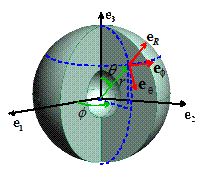
A representative spherically symmetric problem is illustrated in the pic. We consider a hollow, spherical solid, which is subjected to spherically symmetric loading (i.east. internal trunk forces, too as tractions or displacements practical to the surface, are independent of
and
, and deed in the radial management only).
The solution is well-nigh conveniently expressed using a spherical-polar coordinate organisation, illustrated in the figure. For a finite deformation trouble, we demand a style to characterize the position of material particles in both the undeformed and deformed solid. To exercise this, nosotros let
identify a cloth particle in the undeformed solid. The coordinates of the same signal in the plain-featured solid is identified by a new set up of spherical-polar co-ordinates
. I way to describe the deformation would be to specify each of the plain-featured coordinates
in terms of the reference coordinates
. For a spherically symmetric deformation, points merely move radially, and then that
In finite deformation problems vectors and tensors tin be expressed as components in a footing
associated with the position of material points in the undeformed solid, or, if more than convenient, in a basis
associated with material points in the deformed solid. For spherically symmetric deformations the two bases are identical
consequently, we can write
Position vector in the undeformed solid
Position vector in the plain-featured solid
Displacement vector
The stress, deformation gradient and deformation tensors tensors (written as components in
) take the form
and furthermore must satisfy
.
For spherical symmetry, the governing equations reduce to
Strain Deportation Relations
Incompressibility status
Stress Strain relations
Equilibrium Equations
Purlieus Conditions
Prescribed Displacements
Prescribed Tractions
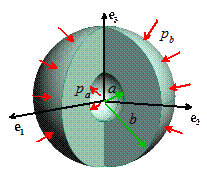 As an instance, consider a pressurized hollow safety shell, equally shown in the pic. Assume that
Earlier deformation, the sphere has inner radius A and outer radius B
After deformation, the sphere has inner radius a and outer radius b
The solid is made from an incompressible Mooney-Rivlin solid, with strain energy potential
No body forces act on the sphere
The inner surface r=a is subjected to pressure level
The outer surface r=b is subjected to pressure
The plain-featured radii a,b of the inner and outer surfaces of the spherical shell are related to the pressure past
where
,
, and
are related by
Provided the pressure is not also big (come across below), the preceding 2 equations can exist solved for
and
given the pressure and backdrop of the shell (for graphing purposes, it is amend to assume a value for
, calculate the respective
, and then determine the pressure level).
The position r of a material particle subsequently deformation is related to its position R earlier deformation by
The deformation tensor distribution in the sphere is
The Cauchy stress in the sphere is
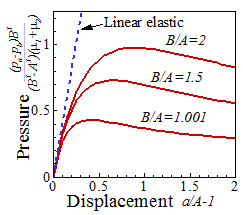 The variation of the internal radius of the spherical beat with applied pressure is plotted in the effigy, for
(a representative value for a typical rubber). For comparison, the linear rubberband solution (obtained by setting
and
in the formulas given in section 4.one.4) is also shown. Annotation that:
1. The small strain solution is accurate for
2. The human relationship between pressure and displacement is nonlinear in the large deformation regime.
3. As the internal radius of the sphere increases, the force per unit area reaches a maximum, and thereafter decreases (this will be familiar behavior to anyone who has inflated a balloon). This is because the wall thickness of the beat out decreases as the sphere expands.
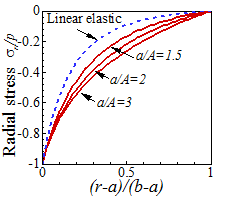
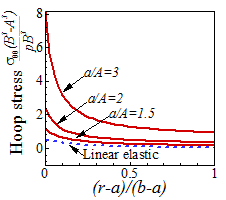
The stress distribution for diverse displacements in the shell is plotted in the figures beneath, for
,
and B/A=iii. The radial stress remains close to the linear rubberband solution even in the large deformation government. The hoop stress distribution is significantly contradistinct equally the deformation increases, even so.
Derivation
1. Integrate the incompressibility condition from the inner radius of the sphere to some capricious point R
two. Note that
by definition, and
since the signal at R=A moves to r=a after deformation. This gives the human relationship between the position r of a point in the deformed solid and its position R before deformation
3. The components of the Cauchy-Green tensor follow as
4. The stresses follow from the stress-strain equation as
v. Substituting these stresses into the equilibrium equation leads to the following differential equation for
6. After substituting for
and
, and expressing R in terms of r, this equation can be integrated and simplified to encounter that
7. The boundary conditions require that
on (r=a,R=A), while
on (r=b,R=B), which requires
where
and
. The expression that relates
and
to the force per unit area follows by subtracting the beginning equation from the 2nd. Calculation the two equations gives the expression for C.
8. Finally, the hoop stress follows by noting that, from (iv)
8.11 Linearized field equations for rubberband materials
In the majority of practical applications, the displacement of the solid is small, in which example the governing equations can be linearized. For this purpose, nosotros assume
1. The solid has a stress free reference configuration at some reference temperature (this is not essential information technology is possible to work with a stressed reference configurations).
2. The displacement gradients are pocket-sized.
We then approximate the field equations as follows:
The mass density is equal in both reference and plain-featured configurations
The Lagrange strain is approximated by the infinitesimal strain
The Cauchy, nominal and material stress are causeless to be identical
The linear momentum residuum equation (expressed in terms of nominal stress) can then be expressed every bit
The constitutive relations are simplified by expressing the free energy, stress, and estrus transfer response functions in terms of infinitesimal strain. The material behavior is characterized by the following functions:
Specific Helmholtz free energy
Strain energy density (Helmholtz free free energy per unit of measurement volume)
Stress response function
Heat flux response function
They are related by
where nosotros have noted that
In add-on, the stress response part is linearized (expand information technology as a Taylor series in
, retaining just the second term and noting that the reference configuration is stress costless)
Here, the
and
are constants (
is chosen the isothermal elastic stiffness tensor)
the values of the constants are material backdrop. They have the following symmetries (because of the symmetry of the second derivative of U and the stress and strain tensors)
and then a general anisotropic material is characterized by 27 fabric properties (21 for
, and 6 for
).
The contribution to the stress associated with changing the temperature (at fixed strain) is often written in a dissimilar form by defining the thermal expansion coefficient which satisfies
The thermal expansion can be visualized physically every bit the strain induced past a temperature modify in a stress gratis solid. The constitutive law so has the form
A linear elasticity problem can be stated as follows:
1. The shape of the solid in its unloaded status
2. 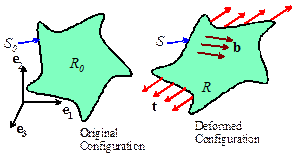 The initial stress field in the solid (we will take this to be cipher)
3. The elastic constants for the solid
and its mass density
4. The thermal expansion coefficients for the solid, and temperature modify from the initial configuration
v. A body force distribution
(per unit mass) acting on the solid
6. Purlieus conditions, specifying displacements
on a portion
or tractions on a portion
of the boundary of R
Calculate displacements, strains and stresses satisfying the governing equations of linear elastostatics
Dynamic problems Dynamic issues are essentially identical, except that the boundary conditions must be specified as functions of time, and the initial displacement and velocity field must be specified. In this example the governing equations are
These field equations tin can be solved fairly hands a few solutions are listed in Section 8.13. These solutions are very useful, but it is important to notation that linearizing the field equations does eliminate some physical beliefs that can be important. In item, the linear momentum balance equation takes derivatives with respect to position in the reference configuration
this means that the equation does not business relationship correctly for re-distributions of stress acquired by irresolute the shape of the solid. Equally a result, geometric instability, such equally buckling, cannot occur.
viii.12 Linear elastic material properties
The symmetries of the elastic stiffness tensor allow us to write the stress-strain relations in a more compact matrix form equally
where
, etc are the rubberband stiffnesses of the material. The inverse has the form
where
, etc are the elastic compliances of the material.
To satisfy Drucker stability, the eigenvalues of the elastic stiffness and compliance matrices must all be greater than zero .
Wellness WARNINGS: Note the gene of 2 in the strain vector . Most texts, and most FEM codes use this cistron of 2, but not all. In improver, shear strains and stresses are ofttimes listed in a different order in the strain and stress vectors. For isotropic materials this makes no difference, but you lot need to exist careful when list material constants for anisotropic materials (see below). In add-on, the shear strain and shear stress components are not ever listed in the club given when defining the rubberband and compliance matrices. The conventions used here are mutual and are particularly convenient in analytical calculations involving anisotropic solids. Merely many sources utilise other conventions. Be careful to enter textile data in the correct order when specifying properties for anisotropic solids.
Physical Estimation of the Anisotropic Rubberband Constants .
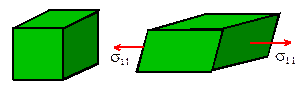 It is easiest to translate
, rather than
. Imagine applying a uniaxial stress, say
, to an anisotropic specimen. In full general, this would induce both extensional and shear deformation in the solid, equally shown in the figure.
The strain induced by the uniaxial stress would exist
All the constants have dimensions
. The abiding
looks like a uniaxial compliance, (like
), while the ratios
are generalized versions of Poisson's ratio: they quantify the lateral wrinkle of a uniaxial tensile specimen. The shear terms are new
in an isotropic textile, no shear strain is induced past uniaxial tension.
Isotropic Materials
The stress-strain laws can be simplified considerably for isotropic materials. In this instance
The inverse human relationship can be expressed equally
Here, Eastward and
are Immature's modulus and Poisson'southward ratio,
is the coefficient of thermal expansion, and
is the increment in temperature of the solid. The remaining relations tin be deduced from the fact that both
and
are symmetric. Young'south modulus and Poisson's ratio are the most mutual properties used to narrate elastic solids, but other measures are also used. For example, nosotros ascertain the shear modulus, bulk modulus and Lame modulus of an rubberband solid as follows:
We can write the linear rubberband stress-strain relations in a much more convenient form using alphabetize notation. Verify for yourself that the matrix expression in a higher place is equivalent to
The inverse relation is
The stress-strain relations are often expressed using the elastic modulus tensor
or the elastic compliance tensor
every bit
In terms of elastic constants,
and
are
8.xiv Reduced field equations for isotropic, linear elastic solids
The governing equations tin can be simplified by eliminating stress and strain from the governing equations, and solving directly for the displacements. In this case the linear momentum balance equation (in terms of displacement) reduces to
For the special case of an isotropic solid with shear modulus
and Poisson ratio
and uniform temperature
this equation reduces to
These are known equally the Navier (or Cauchy-Navier) equations of elasticity.
The boundary conditions remain every bit given in Department 8.12.
8.15 Solutions to elementary static linear elastic boundary value issues
The linearized equations of elasticity tin be solved relatively easily. Further courses will draw the various techniques in more particular, but we list a few examples to give a sense of the general structure of linear elastic solutions.
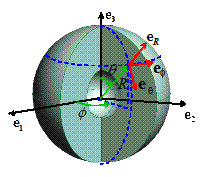 Spherically symmetric bug: A representative spherically symmetric trouble is illustrated in the flick. We consider a hollow, spherical solid, which is subjected to spherically symmetric loading (i.e. internal body forces, as well as tractions or displacements applied to the surface, are independent of
and
, and act in the radial direction only). If the temperature of the sphere is non-uniform, information technology must likewise exist spherically symmetric (a role of R simply).
The solution is most conveniently expressed using a spherical-polar coordinate system, illustrated in the figure. The general procedure for solving issues using spherical and cylindrical coordinates is complicated, and is discussed in particular in Appendix E. In this section, nosotros summarize the special form of these equations for spherically symmetric problems.
Every bit usual, a point in the solid is identified by its spherical-polar co-ordinates
. All vectors and tensors are expressed as components in the basis
shown in the figure. For a spherically symmetric problem
Position Vector
Displacement vector
Trunk force vector
Hither,
and
are scalar functions. The stress and strain tensors (written every bit components in
) have the grade
and furthermore must satisfy
. The tensor components have exactly the same physical interpretation as they did when we used a fixed
basis, except that the subscripts (1,2,3) have been replaced past
.
For spherical symmetry, the governing equations of linear elasticity reduce to
Strain Displacement Relations
Stress Strain relations
Equilibrium Equations
Boundary Conditions
Prescribed Displacements
Prescribed Tractions
Our goal is to solve these equations for the deportation, strain and stress in the sphere. To do so,
1. Substitute the strain-displacement relations into the stress-strain law to show that
2. Substitute this expression for the stress into the equilibrium equation and rearrange the consequence to meet that
Given the temperature distribution and body force this equation tin can easily be integrated to calculate the deportation u. Two arbitrary constants of integration will appear when you do the integral these must be determined from the boundary conditions at the inner and outer surface of the sphere. Specifically, the constants must exist selected so that either the deportation or the radial stress accept prescribed values on the inner and outer surface of the sphere.
In the following sections, this process is used to derive solutions to various purlieus value issues of practical involvement.
Pressurized hollow sphere Assume that
No body forces human activity on the sphere
The sphere has compatible temperature
The inner surface R=a is subjected to pressure
The outer surface R=b is subjected to pressure
The deportation, strain and stress fields in the sphere are
Derivation: The solution can exist constitute past applying the procedure outlined in Sect iv.1.three.
1. Note that the governing equation for u (Sect four.1.3) reduces to
ii. Integrating twice gives
where A and B are constants of integration to be determined.
3. The radial stress follows by substituting into the stress-displacement formulas
4. To satisfy the boundary weather condition, A and B must be chosen so that
and
(the stress is negative considering the pressure level is compressive). This gives two equations for A and B that are hands solved to notice
five. Finally, expressions for displacement, strain and stress follow by substituting for A and B in the formula for u in (2), and using the formulas for strain and stress in terms of u .
Full general 3D static problems: Only as some fluid mechanics bug tin can be solved by deriving the velocity field from a scalar potential, a similar arroyo tin be used to solve elasticity issues. In 3D, a common approach is to derive the solution from and then-called Papkovich-Neuber potentials as follows
The Papkovich-Neuber process tin be summarized every bit follows:
1. Brainstorm by finding a vector function
and scalar function
which satisfy
as well as boundary weather condition
two. Summate displacements from the formula
iii. Calculate stresses from the formula
To see why this procedure works, nosotros demand to show two things:
ane. That the deportation field satisfies the equilibrium equation
2. That the stresses are related to the displacements by the elastic stress-strain equations
To prove the first result, differentiate the formula relating potentials to the displacement to run across that
Substitute this result into the governing equation to see that
Finally, substitute the governing equations for the potentials
and simplify the event to verify that the governing equation is indeed satisfied. The second event can exist derived past substituting the formula for deportation into the elastic stress-strain equations and simplifying.
Indicate forcefulness in an infinite solid. The displacements and stresses induced by a point force
acting at the origin of a large (infinite) elastic solid with Young's modulus E and Poisson's ratio
are generated by the Papkovich-Neuber potentials
where
. The displacements, strains and stresses follow as
Betoken force normal to the surface of an infinite half-infinite 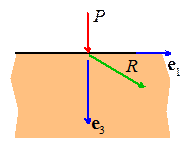 . The displacements and stresses induced by a bespeak force
interim normal to the surface of a semi-infinite solid with Young'due south modulus East and Poisson's ratio
are generated past the Papkovich-Neuber potentials
where
The displacements and stresses follow every bit
Point force tangent to the surface of an infinite half-infinite 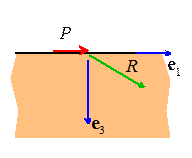 . The displacements and stresses induced by a point force
acting tangent to the surface of a semi-infinite solid with Immature's modulus E and Poisson'south ratio
are generated by the Papkovich-Neuber potentials
The displacements and stresses tin be calculated from these potentials as
Spherical cavity in an space solid subjected to remote stress 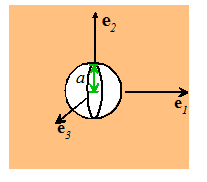 . The figure shows a spherical crenel with radius a in an infinite, isotropic linear rubberband solid. Far from the cavity, the solid is subjected to a tensile stress
, with all other stress components goose egg.
The solution is generated by potentials
The displacements and stresses follow as
8.15 Solutions to simple dynamic elasticity problems
In this department nosotros summarize and derive the solutions to diverse simple bug in dynamic linear elasticity.
Surface subjected to time varying normal pressure 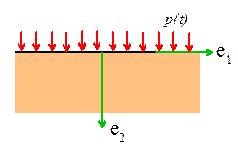 An isotropic, linear elastic half space with shear modulus
and Poisson'due south ratio
and mass density
occupies the region
. The solid is at rest and stress free at time t=0. For t>0 information technology is subjected to a uniform force per unit area p(t) on
as shown in the pic.
Solution: The displacement and stress fields in the solid (as a function of time and position) are
where
is the speed of longitudinal wave propagation through the solid. All other displacement and stress components are zero. For the detail example of a constant (i.e. time independent) pressure, magnitude
, practical to the surface
Evidently, a stress pulse equal in magnitude to the surface pressure propagates vertically through the half-infinite with speed
.
Notice that the velocity of the solid is abiding in the region
, and the velocity is related to the pressure level by
Derivation: The solution can be derived as follows. The governing equations are
The strain-displacement relation
The elastic stress-strain equations
The linear momentum balance equation
Now:
1. Symmetry considerations indicate that the displacement field must take the class
Substituting this equation into the strain-displacement equations shows that the only nonzero component of strain is
.
two. The stress-strain police force and so shows that
In addition, the shear stresses are all zero (because the shear strains are null), and while
are nonzero, they are contained of
and
.
3. The simply nonzero linear momentum remainder equation is therefore
Substituting for stress from (2) yields
where
4. This is a i-D wave equation with general solution
where f and g are ii functions that must be chosen to satisfy boundary and initial weather.
5. The initial conditions are
where the prime denotes differentiation with respect to its argument. Solving these equations (differentiate the first equation and then solve for
and integrate) shows that
where A is some constant.
6. Observe that
for t>0, so that
. Substituting this result back into the solution in (four) gives
.
7. Next, use the boundary condition
at
to meet that
where B is a constant of integration.
eight. Finally, B can be determined by setting t=0 in the result of (7) and recalling from step (5) that
. This shows that B=-A and then
every bit stated.
Surface subjected to fourth dimension varying shear traction 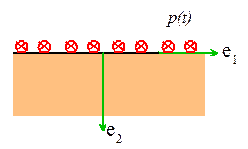 An isotropic, linear elastic half space with shear modulus
and Poisson'southward ratio
and mass density
occupies the region
. The solid is at rest and stress free at fourth dimension t=0. For t>0 it is subjected to a compatible anti-plane shear traction p(t) on
. Calculate the displacement, stress and strain fields in the solid.
Information technology is straightforward to evidence that in this case
where
is the speed of shear waves propagating through the solid. The details are left every bit an practise.
Aeroplane waves in an infinite solid A plane moving ridge that travels in direction p at speed c has a displacement field of the course
where p is a unit vector. Again, to visualize this motion, consider the special case
In this solution, the wave has a planar front end, with normal vector p. The wave travels in direction p at speed c. Ahead of the forepart, the solid is at rest. Behind it, the solid has velocity a. For
the particle velocity is perpendicular to the wave velocity. For
the particle velocity is parallel to the moving ridge velocity. These two cases are like the shear and longitudinal waves discussed in the preceding sections.
We seek plane moving ridge solutions of the Cauchy-Navier equation of motion
Substituting a plane wave solution for u we see that
where
is a symmetric, positive definite tensor known as the `Acoustic Tensor.' Plane wave solutions to the Cauchy-Navier equation must therefore satisfy
This requires
Evidently for any wave propagation direction, in that location are three moving ridge speeds, and 3 corresponding deportation directions, which follow from the eigenvalues and eigenvectors of
For the special case of an isotropic solid
where
is the shear modulus and
is the Poisson'southward ratio of the solid. The acoustic tensor follows as
so that
By inspection, in that location are two eigenvectors that satisfy this equation
1.
(Shear wave, or South-wave)
2.
(Longitudinal, or P-wave)
The two wave speeds are evidently those nosotros found in our 1-D calculation earlier. Then in that location are ii types of plane wave in an isotropic solid. The S-wave travels at speed
, and textile particles are displaced perpendicular to the management of motion of the wave. The P-wave travels at speed
, and fabric particles are displaced parallel to the direction of motion of the wave.
Source: https://www.brown.edu/Departments/Engineering/Courses/En221/Notes/Elasticity/Elasticity.htm
Postar um comentário for "A Cube of Linear Elastic Material Is Again Subjected"