draw line in geogebra 3d
Curves
Autonomously from plotting the graph of a role, GeoGebra tin can also plot a bend that is
- defined by an equation in \(ten\) and \(y\),
- the locus of a signal satisfying some condition,
- a parametric curve.
Implicit functions
GeoGebra distinguishes between explicit functions and functions that are defined implicitly by equations in \(ten\) and \(y\).
An explicit function is written past using brackets ‐ using \(f(x)\)-annotation.
An implicit function tin exist written as \(y=x^2\). In this case \(y\) tin be expressed explicitly in terms of \(x\) and the curve shown, could also exist shown as the graph of the function \(f(x) = 10^ii\). An implicit function all the same, can also have several \(y\)-values corresponding to a \(x\)-value. An implicit office is hence a more general concept than a function. An equation describes a relation betwixt \(x\) and \(y\), and it is not always the case that \(y\) can exist expressed explicitly in terms of \(x\). The equation \(x^2+y^2=one\) defines a bend that is the unit circumvolve. All points \((x, y)\) satisfying the equation prevarication on the curve. The curve is implicitly defined by the equation.
GeoGebra categorizes a bend divers by an equation equally a Line, a Conic, or as an Implicit curve.
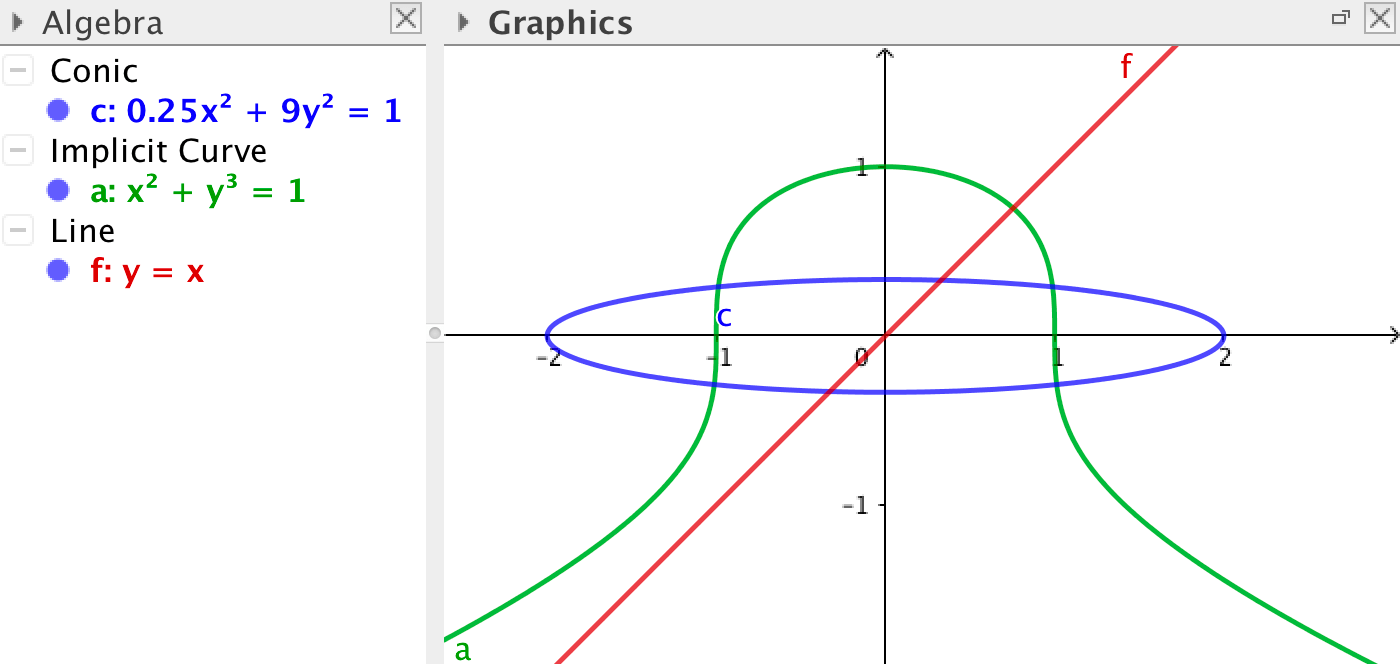
GeoGebra can create implicit curves defined by equations, if the equations are written using polynomials in \(10\) and \(y\). If you lot, for example, write y = sin(x) GeoGebra will classify this equally function, a part that will be given a name by GeoGebra.
Commands that take a office every bit argument, practise not work on conic sections or lines. If a is divers past the equation y=10^ii, you cannot use the command TurningPoint on a. In order to use commands for functions, write it every bit a function, i.east. apply \(f(x)\)-notation!
Locus
If you have a point satisfying some condition, and so the set of all such points is a locus.
To make a locus in GeoGebra, you need a point \(B\) that depends either on another point \(A\) or a slider. The point \(A\) must lie on a curve or a coordinate axis. Using the tool  Locus you tin can then create the locus by showtime clicking on \(B\) so on \(A\) or the slider.
Polar coordinates
In GeoGebra y'all can utilise polar coordinates when defining a indicate. When using polar coordinates, a semicolon is used equally delimiter, equally in A=(r;α). By letting the bending get its value from a slider \(t\), and by defining a office \(r(x)\), it is possible to draw the curve traced out past a point A=(r(t);t). Employ the tool Locus, click on the bespeak and then the slider. Nether the preferences for Graphics, nether the Filigree tab, information technology is possible to show the filigree in polar grade.
Polar coordinates tin be converted to Cartesian coordinates by letting \(x=r\cos(t)\) and \(y=r\sin(t)\). This tin can be used for cartoon the curves as parametric curves instead of a locus.
Parametric curves
If the \(x\)- and the \(y\)-coordinate both depend on a parameter \(t\), they describe a parametric bend with parameter \(t\). Each signal on the bend can be described by the coordinates \((x(t),y(t))\). By letting \(t\) first at a value \(start\) and end at a value \(end\) you lot can draw the curve \(g\) by entering:
k = Curve( ten(t), y(t), t, showtime, stop)
in the input bar.
Y'all tin can e'er convert a regular function to a parametric part. Every bit an example, the graph of \(f(10)=x^ii,-ten\leq 10 \leq 10\) tin can be drawn as a parametric bend by writing the code:
grand = Curve(t, t^ii, t, -10, 10)
By letting a slider stand for the stop-value, it is possible to visualize how a graph is drawn. Create a slider tmax and define the curve as:
k = Curve(t, t^ii, t, -10, tmax)
Transformations and curves
The only transformation you can use on the graph of a regular function is  Translate by Vector.
Autonomously from translating a parametric curve, you lot can also transform information technology by using the transformations  Reverberate well-nigh Line and
 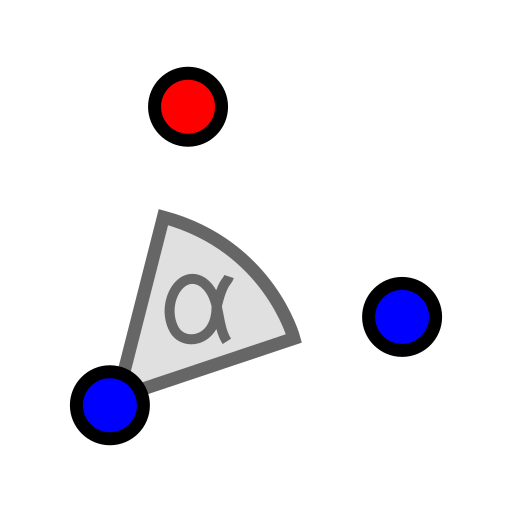 Rotate around Point.
Exercises
Practise 1
Make conic sections
Create four sliders \(a\), \(b\), \(h\) and \(thousand\).
In analytic geometry a parabola can exist defined by the equation
\[y = a(x-h)^2 +k,\]an ellipse by the equation
\[\frac{(10-h)^2}{a^two} + \frac{(y-yard)^2}{b^two} = 1, \]and a hyperbola by the equation
\[\frac{(10-h)^2}{a^2} - \frac{(y-m)^two}{b^two} = one.\]Create the three conic department using these equations.
What effect practice the values of \(h\) and \(k\) take on the three curves?
What effect practice the values of \(a\) and \(b\) take on the ellipse and on the hyperbola?
Do ii
Sun, earth and moon
Create a slider \(R\) representing the radius of the trajectory of the world moving around the sunday.
Create a slider \(r\) representing the radius of the trajectory of the moon moving around the earth.
Create a slider \(m\) taking integer values representing the number of months in a year.
Place a point \(Due south\) (the sun) at the origin.
Version 1 ‐ using degrees and rotations
Create a slider \(\alpha\) taking angle values representing the angle of the earth.
Identify a bespeak \(E\) (the globe) on the positive \(x\)-centrality. The distance between \(S\) and \(Due east\) should be \(R\). Use the tool Rotate around Point to rotate \(E\) around \(Due south\) the angle \(\blastoff\). The rotated point will exist called \(Eastward'\). Hide the point \(Due east\).
Create a point \(M\) (the moon) by writing K = E'+(r, 0). At present \(Thou\) should exist rotated around \(East'\) by an angle depending on the number of months \(grand\) and the angle \(\alpha\). Find this angle and create the rotated point \(M'\). Hide \(Thousand\).
Use the tool Locus. First click on \(M'\) and then on the slider \(\blastoff\).
Version 2 ‐ using radians and trigonometry
Create a slider \(a\) with values between \(0\) and \(2\pi\) representing the angle of the earth.
Let the point \(E\) correspond the earth. Find the \(ten\)- and \(y\)-coordinate of \(East\) in terms of appropriate sliders. Enter the expression for the point in the input bar.
Let \(Thou\) represent the moon. Discover the \(x\)- and \(y\)-coordinate of \(M\) in terms of appropriate sliders. Enter the expression for the betoken in the input bar.
The expressions used for the coordinates of the moon, can likewise be used to make a parametric curve showing the path of the moon. Create this bend. Let the parameter start with the value \(0\) and end with the value \(a\).
Comment: Information technology is possible to evidence images instead of points. The images in the worksheet beneath are from NASA'south image gallery.
Exercise 3
Domain and range for changed trigonometric functions
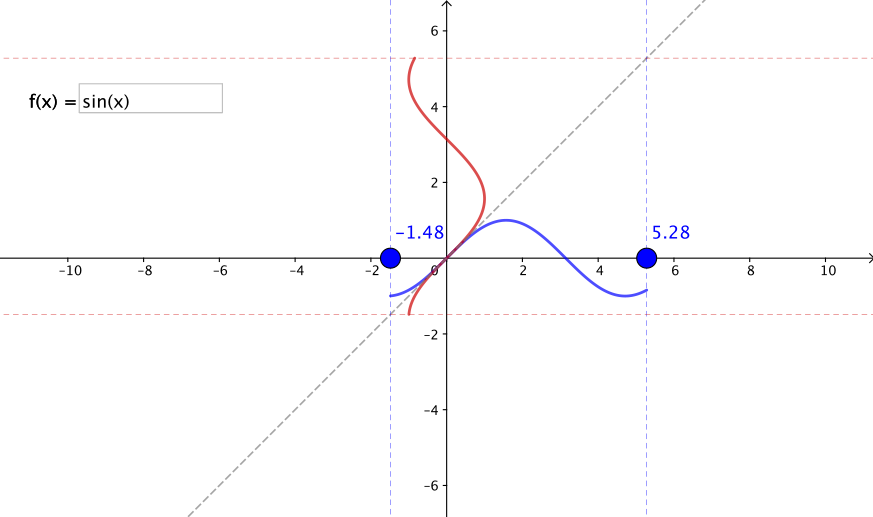
If \(f^{-1}\) is the changed function of a role \(f\), so the graph of \(f^{-1}\) is the reflection of the graph of \(f\) in the line \(y = 10\).
In order to reverberate a graph, information technology must be made as a parametric curve.
-
Ascertain the function
f(x) = sin(ten). Hide the graph. -
Identify two points \(A\) and \(B\) on the \(10\)-axis. The points correspond the finish points of the domain of the function.
Yous can show the \(x\)- or \(y\)-coordinate of a point as a label. Write
%10or%yevery bit Caption in the properties window. -
Create the parametric curve to the function \(f(x)= \sin(x), x(A) \le 10 \le x(B)\).
-
Reflect the curve in \(y=10\). You lot tin either use the tool
Reflect about line or use the command Reflect( <Object>, <Line> ). -
Link \(f\) to an input box using the tool
 Input Box so you easily can redefine the function.
 -
Elevate the points. Report the intervals for which the reflected curve could be the graph of a function. In those cases, what is the domain and what is the range of the inverse function?
Exercise 4
Make a Lissajous curve
A Lissajous bend appears from a periodic motion along the \(x\)-axis and one along the \(y\)-axis.
A Lissajous curve can be described by an equation
\[ \begin{cases} x & = A\sin (at+\delta)\\ y &= B\sin (bt) \terminate{cases} \]An easier equation is used in the worksheet beneath.
Visualize a Lissajous curve in such a manner that the ii periodic motions along the coordinate axes are also shown.
Yous can too brand damped Lissajous curves, see Damped Lissajous Curves for more information.
further info:
Wikipedia: Algebraic curve
Lissajous curves can be drawn past harmonographs
by Malin Christersson under a Creative Commons Attribution-Noncommercial-Share Akin two.five Sweden License
www.malinc.se
Source: https://www.malinc.se/math/geogebra/curvesen.php

Postar um comentário for "draw line in geogebra 3d"